
ANUNNAKIRISMO IL CUORE ANTICO
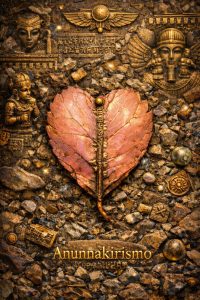
Nel silenzio delle superfici dimenticate, tra pietra e memoria, giace un simbolo che trascende la materia: “Un Cuore Antico”. Non un cuore umano, ma qualcosa di più profondo, più arcaico. Un frammento che sembra provenire da un tempo in cui il linguaggio non era ancora parola, ma incisione, vibrazione, energia. L’opera si presenta come un incontro tra natura e trascendenza. Una foglia, fragile per definizione, diventa metallo, si trasfigura. Le sue venature non sono più semplici linee biologiche, ma canali incisi da una conoscenza antica, quasi sacerdotale. Al centro, una struttura dorata, verticale, sembra fungere da asse: una spina dorsale simbolica che collega terra e cielo, materia e coscienza. Questo è il cuore dell’Anunnakirismo: la trasformazione. Non si tratta di imitare il passato, ma di evocarlo. Le figure attorno, volti ieratici, simboli, iscrizioni, non raccontano una storia precisa, ma suggeriscono una presenza. Sono echi: “Presenze Archetipiche” che osservano, custodiscono, forse giudicano. Non sono lì per essere comprese razionalmente, ma per essere percepite.
Il contrasto è potente: il cuore, simbolo universale di vita ed emozione, è reso eterno dalla materia. Non batte più, ma vibra. Non vive, ma permane. In questa tensione si inserisce il messaggio più profondo dell’opera: ciò che è fragile può diventare eterno, se attraversato dalla consapevolezza. L’Anunnakirismo si muove proprio su questa linea sottile. Non è solo estetica, ma linguaggio simbolico. Non è solo arte, ma codice. Un codice che parla di origine, di memoria ancestrale, di una connessione che l’uomo moderno ha dimenticato, ma non perso del tutto. Guardando quest’opera, non si osserva semplicemente un oggetto. Si entra in un campo. Un campo fatto di stratificazioni temporali, dove il presente si incrina e lascia filtrare qualcosa di più antico, più essenziale. Forse è proprio questo il punto: non capire, ma riconoscere. Perché in fondo, quel cuore…potrebbe non essere, per ciascuno, così estraneo.
ANUNNAKIRISM THE ANCIENT HEART
In the silence of forgotten surfaces, between stone and memory, lies a symbol that transcends matter: ‘An Ancient Heart’. Not a human heart, but something deeper, more archaic. A fragment that seems to come from a time when language was not yet words, but engraving, vibration, energy. The work presents itself as an encounter between nature and transcendence. A leaf, fragile by definition, becomes metal, is transfigured. Its veins are no longer mere biological lines, but channels engraved by an ancient, almost priestly knowledge. At the centre, a golden, vertical structure seems to act as an axis: a symbolic spine connecting earth and sky, matter and consciousness. This is the heart of Anunnakirism: transformation. It is not a matter of imitating the past, but of evoking it.
The figures surrounding it, solemn faces, symbols, inscriptions, do not tell a specific story, but suggest a presence. They are echoes: ‘Archetypal Presences’ that observe, guard, and perhaps judge. They are not there to be understood rationally, but to be perceived. The contrast is powerful: the heart, a universal symbol of life and emotion, is rendered eternal by matter. It no longer beats, but vibrates. It does not live, but endures. It is within this tension that the work’s deepest message lies: that which is fragile can become eternal, if imbued with awareness. Anunnakirism operates precisely along this fine line. It is not merely aesthetics, but symbolic language. It is not merely art, but a code. A code that speaks of origin, of ancestral memory, of a connection that modern man has forgotten, but not entirely lost. When looking at this work, one is not simply observing an object. One enters a realm. A realm made up of layers of time, where the present cracks open and allows something older, more essential, to shine through. Perhaps that is precisely the point: not to understand, but to recognise. Because, after all, that heart… might not be so foreign to each of us.
